 Business License

Regarding FRP Barrier Fence
I. Say goodbye to frequent maintenance: How does FRP fence revolutionize the traditional approach?
In municipal engineering, industrial parks, or power facilities, have you ever been fed up with the annual rust removal and painting of metal fences, or the rapid decay of wooden fences? The emergence of FRP (Fiber Reinforced Plastic, glass fiber reinforced plastic) fences has completely changed the rules of the game for protective facilities. This composite material, centered around glass fibers and resin, has a density of only 1/4 that of steel, yet its tensile strength exceeds 200 MPa, and it can remain intact in extreme environments ranging from -50°C to 120°C, with a service life of over 25 years.
A coastal city's river barrier project provides the most direct answer: After 10 years of using FRP fences, there is no rust or fading, and the maintenance cost is only 20% of that of galvanized steel; while the metal fences installed during the same period have already been replaced twice due to salt fog corrosion. This "one-time installation, lifelong peace of mind" feature makes FRP fences the preferred choice for users seeking long-term value.
II. All-round Adaptability: Full-scenario coverage from municipal to military applications
The advantages of FRP fences go far beyond weather resistance; their multi-scenario adaptability is a benchmark in the industry:
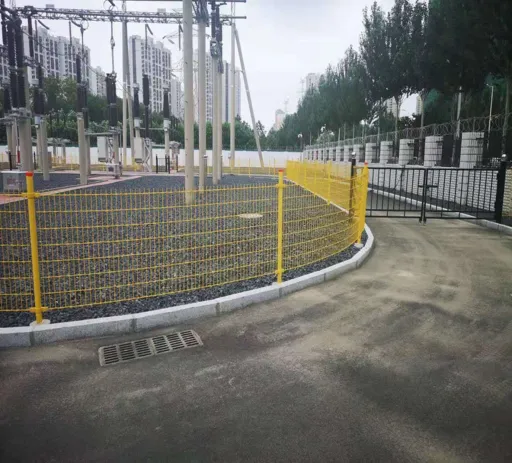
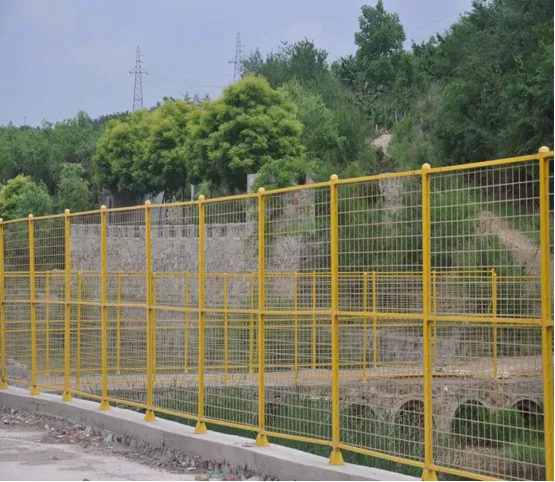
Municipal and People's Livelihood: Park, school, river barrier fences can be customized with wood grain / stone grain appearance, with vertical pole spacing ≤ 11cm (in accordance with GB 4053.3-2009 standards), eliminating potential safety hazards for children;
Industry and Chemicals: Chemical plant, sewage treatment plant choose vinyl ester resin material, resistant to 98% sulfuric acid fog corrosion, with a lifespan over 5 times that of carbon steel fences;
Power and High Voltage: Substation, transmission line fences have an insulation resistance ≥ 100 MΩ, can withstand 50kV high voltage, completely eliminating the risk of conductive, becoming a safety benchmark for the power industry;
High Security Requirements: Prisons, military restricted areas can be designed with a height of ≥ 2.5m, with top anti-climbing spikes or electronic fences added, with impact resistance up to IK10 (GB/T 20138 standards);
Extreme Environments: Coastal salt fog areas, frozen soil zones, high-pollution industrial areas, all can maintain stable performance with a temperature range of -60°C to 150°C and anti-ultraviolet coating;
III. Selecting FRP Fences without Blunders: 3 Minutes to Understand the Core Parameters of FRP Fences
When choosing FRP fences, grasp the following key points to avoid pitfalls:
Material Selection: General scenarios choose isopropyl type unsaturated polyester resin (high cost-effectiveness), choose vinyl ester resin for strong acid and strong alkali environments (more corrosion resistance);
Structural Specifications: Height in ordinary areas ≥ 1.2m (in accordance with GB 50352-2019), pole spacing ≤ 2.0m (wind resistance design), ≥ 2.5m for high-voltage areas;
Function Upgrades: Outdoor scenarios must select anti-UV coating, add vibration sensors for security requirements, grounding design + bird spikes for power scenarios;
Installation Method: Permanent fences choose pre-buried type (ground anchor bolt depth ≥ 400mm), temporary fences choose flange type (expansion bolt fixation), adjustable angle connectors for slopes (adaptation ≤ 30° slope).
IV. Industry Trends: Three Major Development Directions of FRP Fences in 2025
According to industry reports, the global FRP fence market size will grow at an average annual rate of 7.5% from 2025 to 2030, and the Chinese market is expected to exceed 30 billion yuan. In the future, FRP fences will evolve in three directions:
Greening: 100% recyclable materials become the mainstream, with the recycling rate increasing to over 30% according to policy requirements; Intelligence: The proportion of intelligent fences equipped with RFID tags and infrared alarm modules will reach 15%, enabling full lifecycle management;
High-end: New technologies such as self-repairing coatings and photovoltaic integration are accelerating their implementation, and new energy (photovoltaic power stations, 5G base stations) have become new growth points, with growth rates exceeding 15%.
V. Final Recommendation: Who Should Choose FRP Fencing?
If your project meets any of the following conditions, FRP fencing will be the optimal solution:
Seeking long-term cost-effectiveness and unwilling to bear the annual maintenance costs;
In harsh installation environments (coastal areas, chemical zones, high-voltage zones);
Valuing aesthetics and environmental harmony, requiring customized appearance;
Concerning environmental protection and desiring to select recyclable materials.
From municipal engineering to industrial protection, from public safety to military security, FRP Barrier Fence uses material technology to redefine the standard of protection. It is not only a physical barrier but also a worry-free, safe, and sustainable modern engineering solution.
Recently Posted
-
FRP guardrail net
December 1, 2025This product has a wide range of applications, from high-speed rail, hydropower, water conservancy, coastal defense, sea areas, in Read More
 -
FRP mesh sheet
December 1, 2025Zeke New Materials (Shandong) Co., Ltd. was established in 2025. It is a comprehensive enterprise specializing in th Read More
 -
FRP Barrier Fence
November 26, 2025FRP, or Glass Fiber Reinforced plastic, is also known as fiberglass reinforced plastic. It is mainly composed of fiberglass r Read More